
Running a Sex Offender Check in Lee County
The Georgia Sex Offender Registry, often called SORT, is the first public channel for a Lee County sex offender check. The Georgia Bureau of Investigation manages the central system. County sheriffs supply and verify much of its local data. A name search is useful when identity is known. County, city, ZIP, address, radius, and map controls are better for community awareness near a place.
Begin with the narrowest facts that are reliable, then broaden the query. Try an alias or spelling variant when a name produces no result. For a place search, remember that postal city labels and county lines do not always match. Review the registration and last-verification details on the profile instead of treating the first address shown as timeless. The GBI warns that information changes often and does not guarantee complete accuracy.
Lee County Registry Data Changes
A Lee County registry result is a current public record assembled from reports by registering agencies. A move, a new work location, a vehicle change, or a new verification can alter a profile. Search terms also affect what appears. A missing match may reflect a spelling issue, timing, a nonpublic legal category, a person registered elsewhere, or no duty to register.
The GBI registry overview explains the state system and links to official law and data. Its neutral interface is shown below, without making a private person the subject.
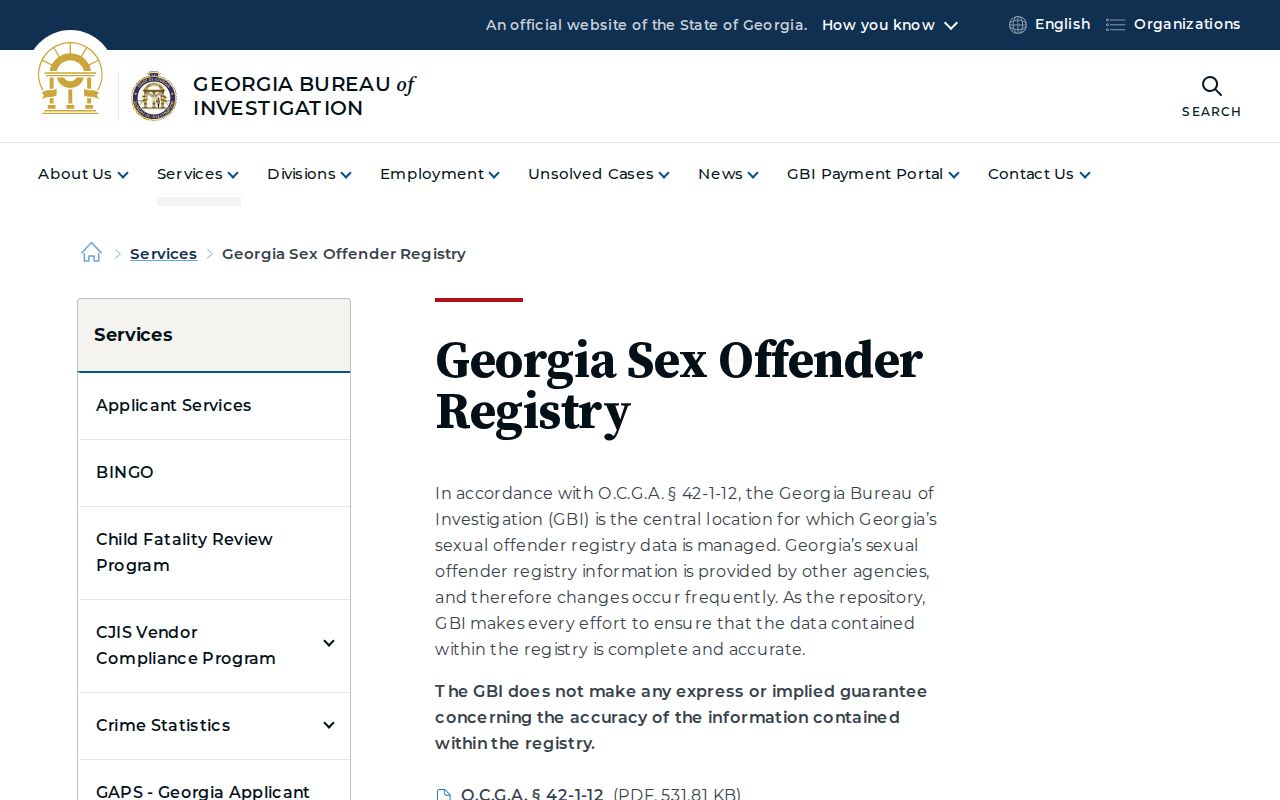
The state explanation is a useful check on what a Lee County registry search can and cannot establish. Confirm a disputed or stale detail with the sheriff rather than drawing a conclusion from one screen.
Note: Registry information can change after a move or verification, so record the profile date and confirm time-sensitive facts with the sheriff.
Searching the Georgia Sex Offender Registry
The public SORT portal offers name and geographic routes. No single field is the right choice for every Lee County sex offender check. A known person calls for a name search. A neighborhood question calls for a county, city, ZIP, address, radius, or map search. Use the portal’s conditions and notices as part of the record, not as text to click past.
- Open the official Georgia registry and read its terms and accuracy notice.
- Choose a name search or a location search, then enter only facts you can verify.
- Review possible results carefully, using aliases and physical details to avoid a false match.
- Open the profile and check status, offense, jurisdiction, address, and verification dates before contacting the Lee County Sheriff if confirmation is needed.
| Field label | Type | Required | Use |
|---|---|---|---|
| First and last name | Text | Search-dependent | Known-person search; try supported aliases or spelling variants |
| Offender type or status | Select | No | Narrows results when the live interface offers the choice |
| County, city, or ZIP | Select or text | Search-dependent | Limits a geographic search to Lee County or a local place |
| Address and radius | Text and map control | Search-dependent | Checks an area around a known point |
Lee County Registration Desk
People subject to Georgia registration rules report through the sheriff in the county where they reside. In Lee County, that means the Sheriff’s office at the Criminal Justice Center. The office is also the sound fallback when a public Lee County registry profile appears out of date or suspected noncompliance needs to be reported.
Lee County Sheriff
Registry and compliance contact
119 Pinewood Road
Leesburg, GA 31763
(229) 759-3334
Confirm registration appointment procedures and hours by phone.
Report facts, not guesses. Give the profile, address, date, and observed issue. Do not confront anyone or try to enforce a registration rule yourself. If there is an immediate threat, use emergency services rather than an online form or routine records channel.
The GBI registration FAQ documents duties and timing. The captured official page below keeps the focus on rules, not on a registrant.
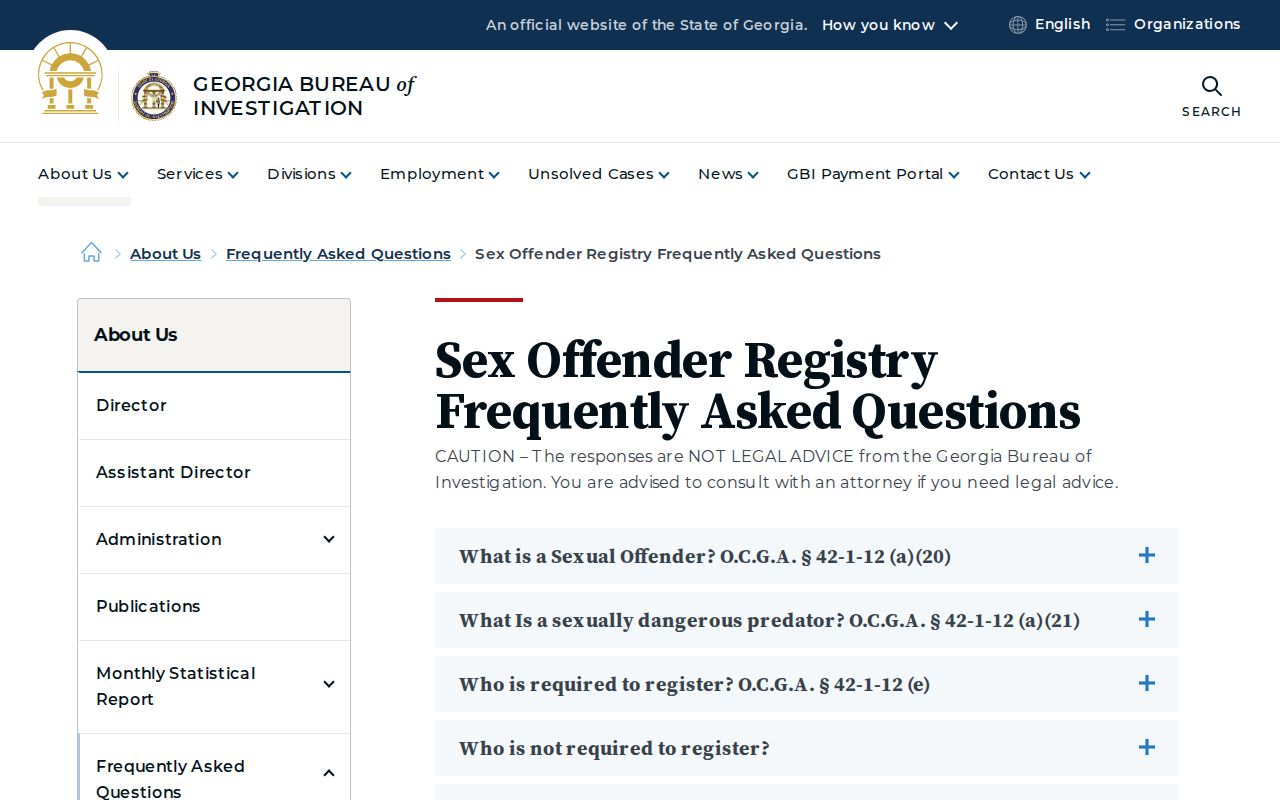
That state source helps separate a statutory deadline from a profile’s display date. The sheriff can confirm how a duty applies to a current Lee County report.
What a Registry Profile Shows
A public profile organizes identity, location, offense, and compliance fields. Read fields together. A photograph or name alone does not resolve every identity question, and the offense label does not tell the whole court history. When the underlying disposition matters, use the originating court record as the stronger source.
| Name and aliases | Primary name and alternate names reported for registry use. |
|---|---|
| Photo and description | Photograph plus sex, race, age or date of birth, and physical descriptors. |
| Residence and jurisdiction | Publicly displayed address information and the registering jurisdiction. |
| Offense information | Conviction offense, jurisdiction, date, and statute or category when supplied. |
| Status and verification | Registration or compliance status, supervising or registering agency, and verification dates. |
| Other public fields | Scars, marks, tattoos, vehicles, and work or school data when Georgia law permits display. |
Georgia does not use a simple public Tier I, II, and III chart for all profiles. Avoid importing federal labels or another state’s duration table. The displayed Georgia status and current statutes control.
Lee County and National Searches
A Lee County sex offender search answers a local Georgia question. It may not follow a person across a state line. The U.S. Department of Justice operates the National Sex Offender Public Website, which queries participating jurisdictions and is the right second layer for travel, relocation, or an address near a border.
NSOPW does not replace Georgia SORT. Each participating jurisdiction controls its own source data and public rules. Search the Georgia portal for the detailed state profile, then use the national tool for breadth. The official national search interface is captured below with no individual selected.
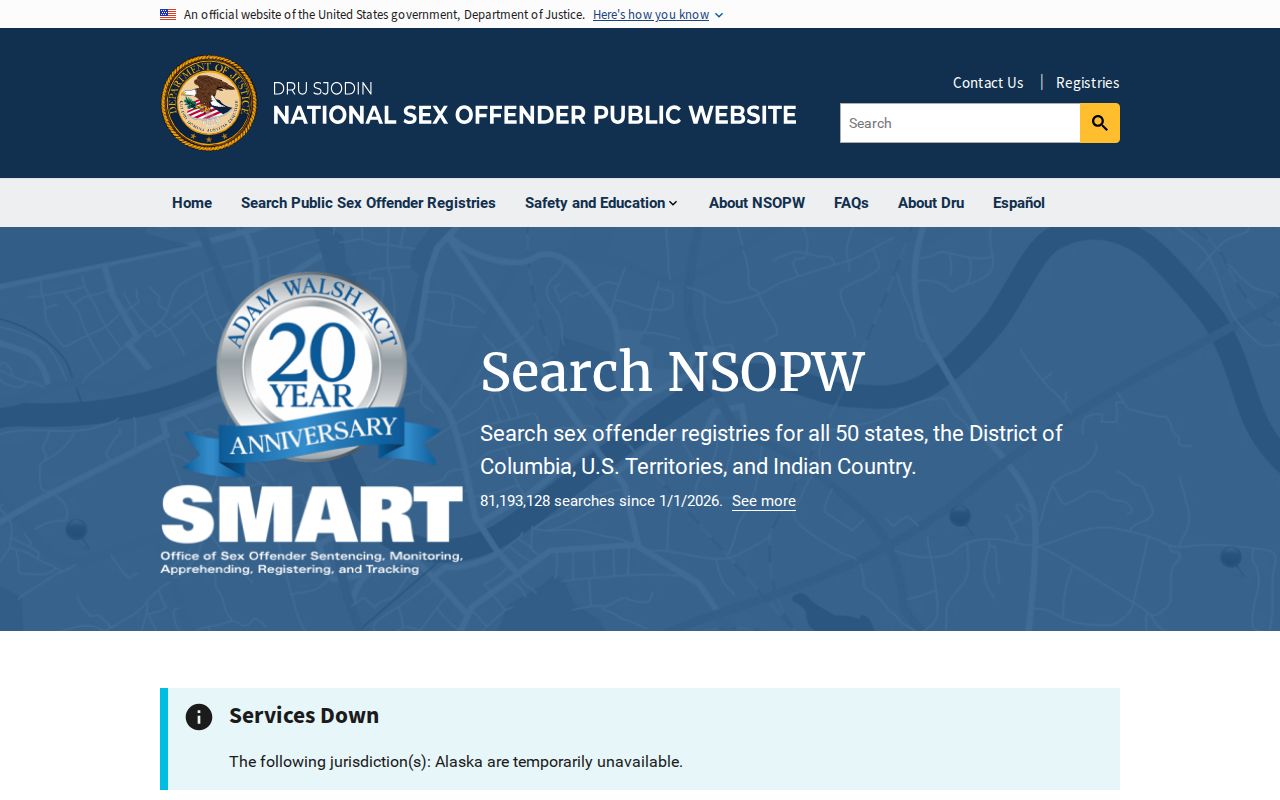
The national layer helps locate the proper jurisdiction. Follow any match back to the official state profile and agency before relying on it.
Registration Requirements and Levels in Georgia
O.C.G.A. §42-1-12 sets Georgia’s registration framework. A person covered by the statute generally must report in person to the sheriff within the specified 72-hour triggers after release, placement on supervision, or entry into Georgia. Other changes can trigger duties as well. The exact rule depends on residence, work, school, conviction date, offense, and legal designation.
| Georgia category | Duration | Verification |
|---|---|---|
| Statute-covered registrant | Depends on offense, conviction date, and removal eligibility | In-person sheriff duties and change reports under current law |
| Sexually dangerous predator | Enhanced or lifetime consequences apply | Distinct requirements set by Georgia law and designation |
| Removal-eligible person | Only after statutory conditions are met | Review O.C.G.A. §§42-1-12 and 42-1-19; no automatic public tier rule |
The Georgia Crime Information Center maintains related services and forms. This state context matters when a Lee County registry question overlaps a criminal-history correction. The sheriff handles registration facts; the court and GCIC have separate roles for case and repository records.
Correcting Lee County Registry Questions
When a profile looks stale, first note the exact field and the date shown. Compare the state profile with the sheriff’s current information. An address dispute is different from an offense or disposition dispute. The sheriff can address registration and verification facts, while the originating court remains the source for the conviction record.
The GBI criminal-history FAQ explains how repository content and correction channels differ without exposing a private record.
A correction request should go to the custodian able to change that field. Sending an address issue to a court, or a conviction issue to the registry desk, can slow the answer.
Note: Preserve the profile date and field at issue so the sheriff or GBI can understand what appeared when you searched.
Report Lee County Noncompliance Safely
Suspected noncompliance belongs with law enforcement, not in a public confrontation. Call the Lee County Sheriff and describe the exact profile, address, date, and fact that appears inconsistent. Staff can compare the report with registration and verification records that are not fully visible to the public.
Do not assume a missed search result or an old-looking address proves a crime. Search scope, spelling, recent moves, verification timing, and legal display rules can all affect the screen. For an urgent threat, contact emergency services. For a routine registry discrepancy, use the sheriff’s main line or the GBI registry channel and preserve the date of the public result.
Lawful Use and Community Notification
Public registry access supports personal and family safety and informed community awareness. It does not grant power to punish, threaten, shame, or monitor a listed person. Presence on the registry means the person is subject to registration law. It does not justify assumptions beyond the official fields.
Use agency channels for suspected noncompliance. Give the Lee County Sheriff factual details and let trained staff verify the report. The Georgia registry’s warnings and O.C.G.A. §42-1-12 govern public use alongside other criminal and civil law.
Use registry data lawfully: Harassing, threatening, intimidating, or using registry information for vigilantism is prohibited and may lead to criminal or civil consequences under Georgia law.